List of variables
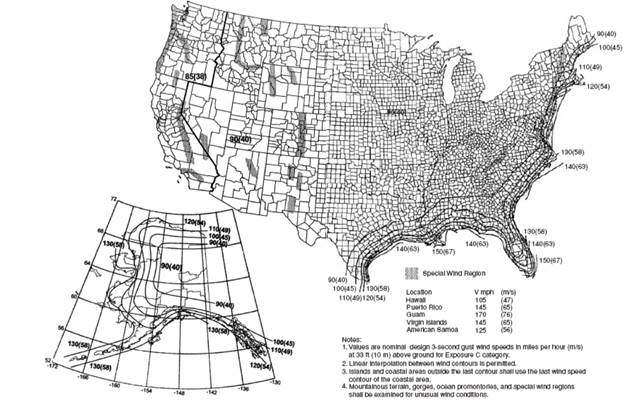
Figure 6-1 Basic Wind Speed
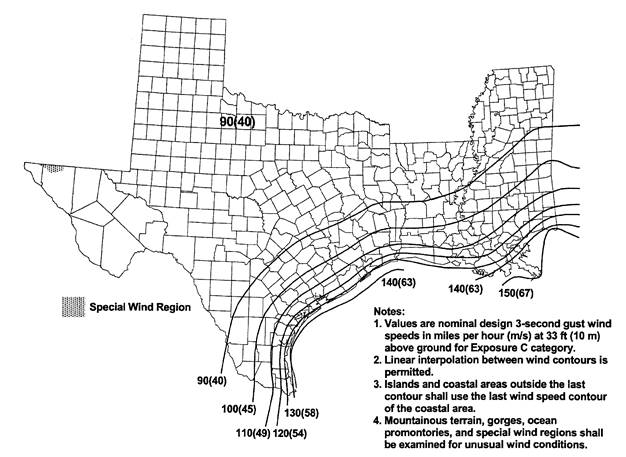
Figure 6-1a Basic Wind Speed - Western Gulf of Mexico Hurricane Coastline
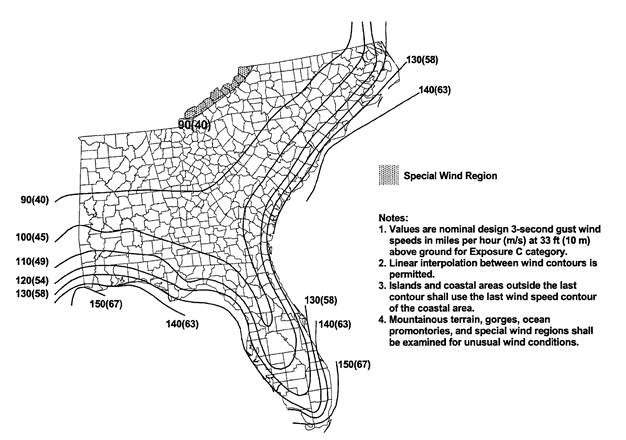
Figure 6-1b Basic Wind Speed – Eastern Gulf of Mexico and Southeastern US Hurricane Coastline
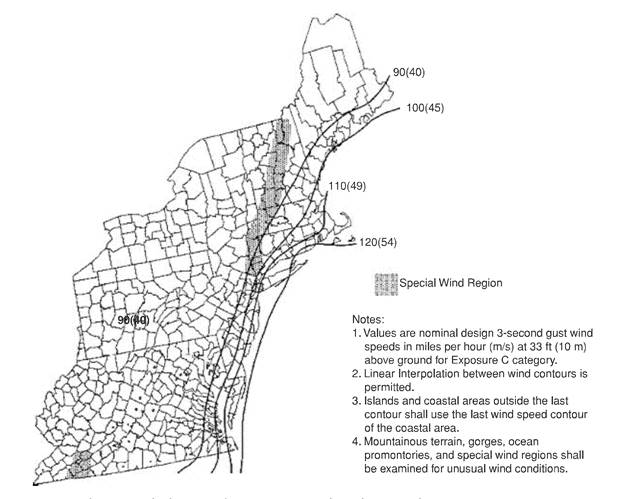
Figure 6-1c Basic Wind Speed – Mid and Northern Atlantic Hurricane Coastline
TABLE 1-1 OCCUPANCY CATEGORY OF BUILDINGS AND OTHER STRUCTURES FOR FLOOD, WIND, SNOW, EARTHQUAKE, AND ICE LOADS
|
Nature of Occupancy |
Occupancy Category |
|
Buildings and other structures that represent a low hazard to human life in the event of failure, including, but not limited to: · Agricultural facilities · Certain temporary facilities · Minor storage facilities |
I |
|
All buildings and other structures except those listed in Occupancy Categories I, III and IV |
II |
|
Buildings and other structures that represent a substantial hazard to human life in the event of failure, including, but not limited to: · Buildings and other structures where more than 300 people congregate in one area · Buildings and other structures with daycare facilities with a capacity greater than 150 · Buildings and other structures with elementary school or secondary school facilities with a capacity greater than 250 · Buildings and other structures with a capacity greater than 500 for colleges or adult education facilities · Health care facilities with a capacity of 50 or more resident patients, but not having surgery or emergency treatment facilities · Jails and detention facilities
Buildings and other structures, not included in Occupancy Category IV, with potential to cause a substantial economic impact and/or mass disruption of day-to-day civilian life in the event of failure, including, but not limited to: · Power generating stations a) · Water treatment facilities · Sewage treatment facilities · Telecommunication centers
Buildings and other structures not included in Occupancy Category IV (including, but not limited to, facilities that manufacture, process, handle, store, use, or dispose of such substances as hazardous fuels, hazardous chemicals, hazardous waste, or explosives) containing sufficient quantities of toxic or explosive substances to be dangerous to the public if released. Buildings and other structures containing toxic or explosive substances shall be eligible for classification as Occupancy Category IV structures if it can be demonstrated to the satisfaction of the authority having jurisdiction by a hazard assessment as described in Section 1.5.2 that a release of the toxic or explosive substances does not pose a threat to the public. |
III |
|
Buildings and other structures designated as essential facilities, including, but not limited to: · Hospitals and other health care facilities having surgery or emergency treatment facilities · Fire, rescue, ambulance, and police stations and emergency vehicle garages · Designated earthquake, hurricane, or other emergency shelters · Designated emergency preparedness, communication, and operation centers and other facilities required for emergency response · Power generating stations and other public utility facilities required in an emergency · Ancillary structures (including, but not limited to, communication towers, fuel storage tanks, cooling towers, electrical substation structures, fire water storage tanks or other structures housing or supporting water, or other fire-suppression material or equipment) required for operation of Occupancy Category IV structures during an emergency · Aviation control towers, air traffic control centers, and emergency aircraft hangars · Water storage facilities and pump structures required to maintain water pressure for fire suppression · Buildings and other structures having critical national defense functions
Buildings and other structures (including, but not limited to, facilities that manufacture, process, handle, store, use, or dispose of such substances as hazardous fuels, hazardous chemicals, or hazardous waste) containing highly toxic substances where the quantity of the material exceeds a threshold quantity established by the authority having jurisdiction. Buildings and other structures containing highly toxic substances shall be eligible for classification as Occupancy Category II structures if it can be demonstrated to the satisfaction of the authority having jurisdiction by a hazard assessment as described in Section 1.5.2 that a release of the highly toxic substances does not pose a threat to the public. This reduced classification shall not be permitted if the buildings or other structures also function as essential facilities. |
IV |
a) Cogeneration power plants that do not supply power on the national grid shall be designated Occupancy Category II.
Exposure B: Exposure B shall apply where the ground surface roughness condition, as defined by Surface Roughness B, prevails in the upwind direction for a distance of at least 2,600 ft (792 m) or 20 times the height of the building, whichever is greater.
EXCEPTION: For buildings whose mean roof height is less than or equal to 30 ft, the upwind distance may be reduced to 1,500 ft (457 m).
Exposure C: Exposure C shall apply for all cases where Exposures B or D do not apply.
Exposure D: Exposure D shall apply where the ground surface roughness, as defined by Surface Roughness D, prevails in the upwind direction for a distance greater than 5,000 ft (1,524 m) or 20 times the building height, whichever is greater. Exposure D shall extend into downwind areas of Surface Roughness B or C for a distance of 600 ft (200 m) or 20 times the height of the building, whichever is greater.
For a site located in the transition zone between exposure categories, the category resulting in the largest wind forces shall be used.
EXCEPTION: An intermediate exposure between the preceding categories is permitted in a transition zone provided that it is determined by a rational analysis method defined in the recognized literature.
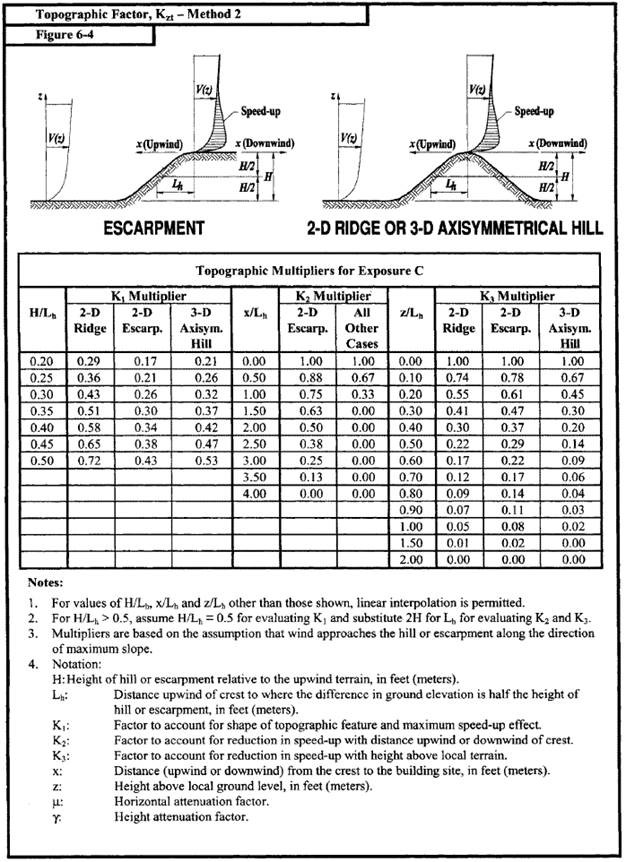
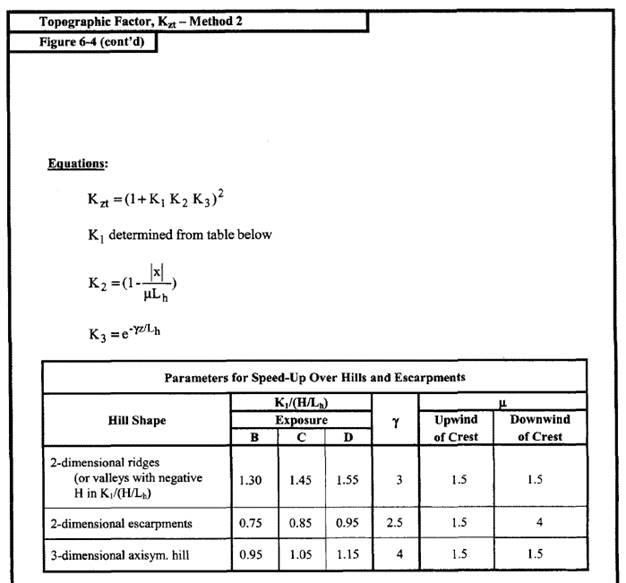
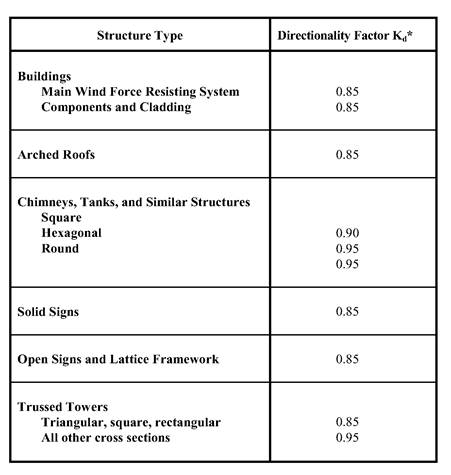
*Directionality Factor Kd has been calibrated with combinations of loads specified in Section 2. This factor shall only be applied when used in conjunction with load combinations specified in 2.3 and 2.4.