DEE-e
The accommodation coefficient γ can be calculated by means of the correlation:
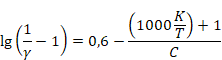
Here, T is the absolute temperature. The quantity C depends on the molar mass of the gas (He: C = 50, H2O: C = 3.6, air: C = 2.8).
The surface roughness of the particles can be estimated with the help of, e.g., REM-pictures. Schlünder uses δ = 0 for glass, polymeric, and metallic particles, whereas Mollekopf applies a value of δ = 2.5 μm for particles made of aluminum silicate.
Shape factors and flattening coefficients
|
Particle shape |
Cf |
φ |
Material |
|
Spherical |
1,25 |
0,0077 |
Ceramic |
|
0,0013 |
Steel |
||
|
0,0253 |
Copper |
||
|
Cylindrical |
2,50 |
? |
|
|
Raschig rings |
2,5[1+(di/da²)] |
? |
|
|
Irregular (broken) |
1,40 |
0,0010 |
Sand |
Shape factors and flattening coefficients
|
Particle shape |
Cf |
φ |
Material |
|
Spherical |
1,25 |
0,0077 |
Ceramic |
|
0,0013 |
Steel |
||
|
0,0253 |
Copper |
||
|
Cylindrical |
2,50 |
? |
|
|
Raschig rings |
2,5[1+(di/da²)] |
? |
|
|
Irregular (broken) |
1,40 |
0,0010 |
Sand |