EC8-e
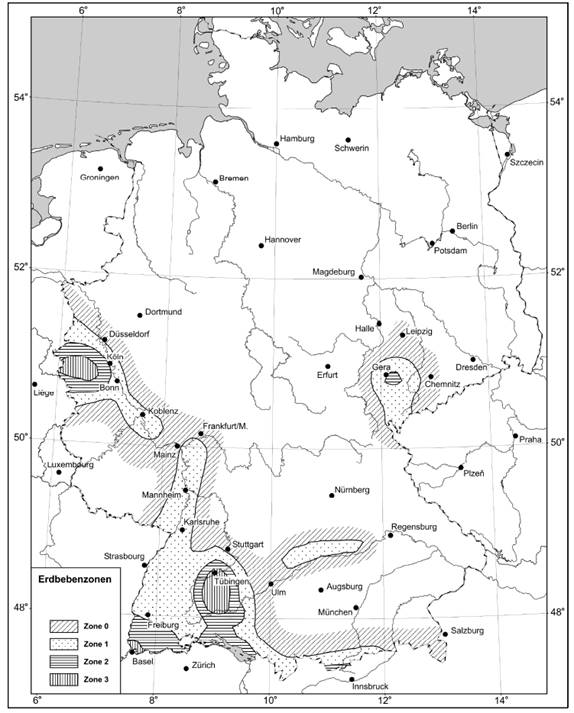
Fig. NA. 1 – Scheme of seismic zones in the Federal Republic of Germany
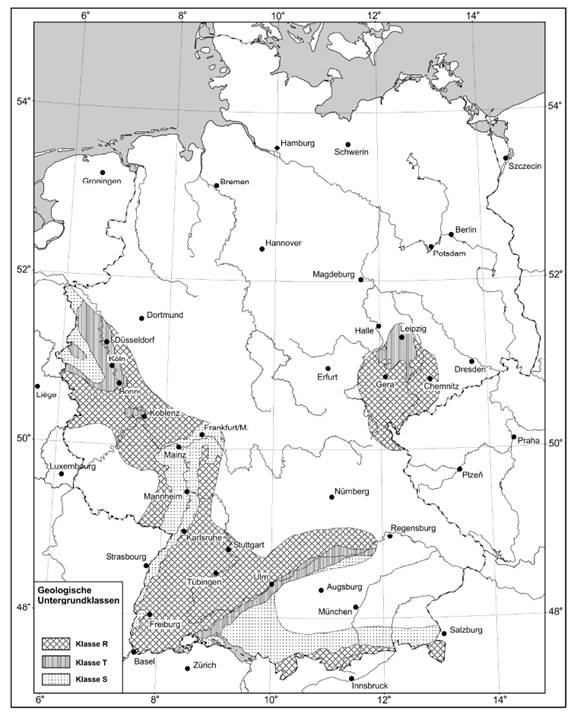
Fig NA. 2 – Scheme of geological ground types in the seismic zones of the Federal Republic of Germany
Table NA.4 - Values of the parameters describing the elastic horizontal response spectra
|
Ground types |
S |
TB |
TC |
TD |
|
A-R |
1,00 |
0,05 |
0,20 |
2,0 |
|
B-R |
1,25 |
0,05 |
0,25 |
2,0 |
|
C-R |
1,50 |
0,05 |
0,30 |
2,0 |
|
|
|
|
|
|
|
B-T |
1,00 |
0,1 |
0,30 |
2,0 |
|
C-T |
1,25 |
0,1 |
0,40 |
2,0 |
|
|
|
|
|
|
|
C-S |
0,75 |
0,1 |
0,5 |
2,0 |
Table 3.1 – Ground Types
|
Ground type |
Description of stratigraphic profile |
Parameters |
||
|
Vs,30 (m/s) |
NSPT |
Cu (kPa) |
||
|
A |
Rock or other rock-like geological formation, including at most 5 m of weaker material at the surface. |
> 800 |
- |
- |
|
B |
Deposits of very dense sand, gravel, or very stiff clay, at least several tens of metres in thickness, characterised by a gradual increase of mechanical properties with depth. |
360 – 800 |
> 50 |
> 250 |
|
C |
Deep deposits of dense or medium dense sand, gravel or stiff clay with thickness from several tens to many hundreds of metres. |
180 – 360 |
15 – 50 |
70 – 250 |
|
D |
Deposits of loose-to-medium cohesionless soil (with or without some soft cohesive layers), or of predominantly soft-to-firm cohesive soil. |
< 180 |
< 15 |
< 70 |
|
E |
A soil profile consisting of a surface alluvium layer with vs values of type C or D and thickness varying between about 5 m and 20 m, underlain by stiffer material with vs > 800 m/s |
|
|
|
|
S1 |
Deposits consisting, or containing a layer at least 10 m thick, of soft clays/silts with a high plasticity index (PI > 40) and high water content |
<
100 |
- |
10 – 20 |
|
S2 |
Deposits of liquefiable soils, of sensitive clays, or any other soil profile not included in types A – E or S1 |
|
|
|
Table NA.4 - Values of the parameters describing the elastic horizontal response spectra
|
Ground type |
S |
TB |
TC |
TD |
|
A-R |
1,00 |
0,05 |
0,20 |
2,0 |
|
B-R |
1,25 |
0,05 |
0,25 |
2,0 |
|
C-R |
1,50 |
0,05 |
0,30 |
2,0 |
|
|
|
|
|
|
|
B-T |
1,00 |
0,1 |
0,30 |
2,0 |
|
C-T |
1,25 |
0,1 |
0,40 |
2,0 |
|
|
|
|
|
|
|
C-S |
0,75 |
0,1 |
0,5 |
2,0 |
Table NA.6 — Importance classes and importance factors
|
Importance class |
Buildings |
Importance factor |
|
I |
Buildings of minor importance for public safety, e.g. agricultural buildings, etc. |
0,8 |
|
II |
Ordinary buildings, not belonging in the other categories (e.g. smaller homes and office buildings or workshops). |
1,0 |
|
III |
Buildings whose seismic resistance is of importance in view of the consequences associated with a collapse, e.g. schools, assembly halls, cultural institutions, stores etc. |
1,2 |
|
IV |
Buildings whose integrity during earthquakes is of vital importance for civil protection, e.g. hospitals, fire stations, power plants, etc. |
1,4 |
Reinforced concrete structures have the capacity to dissipate energy, mainly by means of the ductile behaviour of their elements. The structural seismic response, which is reduced by the influence of ductility, is considered in the design spectrum for elastic analysis, according to the behaviour factor q.
The behaviour factor q depends on the structural type, the regularities in plan and elevation and the ductility class. The more ductile the material the higher the behaviour factor can be used. A usage of values greater than 1.5 must be proofed accordingly.
|
Category |
Type |
Ψ2 |
φ |
|
A |
Living spaces and lounges |
0,3 |
0,7 |
|
B |
Offices, work areas, hallways |
||
|
C |
Assembly rooms and areas that might serve for large gatherings of people |
0,6 |
|
|
D |
Shops |
1,0 |
|
|
E |
Storage rooms, factories and workshops, warehouses and gateways |
0,8 |
|
|
F |
Vehicle traffic with vehicle weight ≤ 30kN |
0,6 |
|
|
Most upper floor (independent of category) |
1,0 |
||
For the following non-structural elements the importance factor γa shall not be less than 1,5:
· anchorage elements of machinery and equipment required for life safety systems,
· tanks and vessels containing toxic or explosive substances considered to be hazardous to the safety of the general public.
In all other cases the importance factor γa of non-structural elements may be assumed to be γa=1,0.
Table 4.4 – Values of qa for non-structural elements
|
Type of non-structural element |
qa |
|
Cantilevering parapets or ornamentations Signs and billboards Chimneys, masts and tanks on legs acting as unbraced cantilevers along more than one half of their total height |
1,0 |
|
Exterior and interior walls Partitions and facades Chimneys, masts and tanks on legs acting as unbraced cantilevers along less than one half of their total height, or braced or guyed to the structure at or above their centre of mass Anchorage elements for permanent cabinets and book stacks supported by the floor Anchorage elements for false (suspended) ceilings and light fixtures |
2,0 |