KF-e
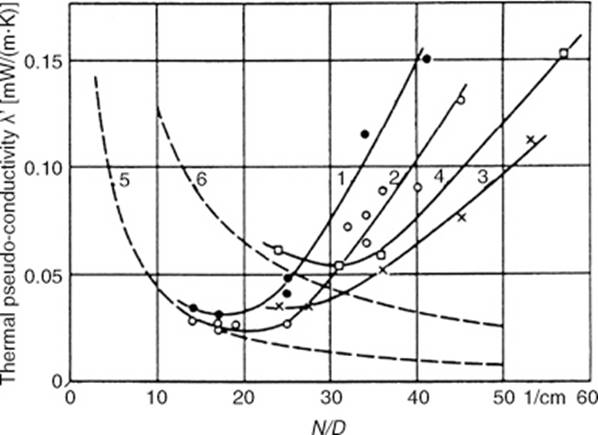
Fig. 4 - “Pseudo”- thermal conductivity, λ', of multifoil superinsulations, as a function of the number of foils, N, per unit thickness of insulation, D. The figure is from [1]. Curves 1- 3: aluminum foil with fiberglass paper of various thicknesses; Curve 4: vacuum-aluminized Dracon film with woven glass fabric, Curves 5 and 6: theoretical values (with no allowance for solid-contact conduction) calculated from εFoil = 0.04 and 0.12. Wall temperatures T 1 = 293 K and T 2 = 90 K.
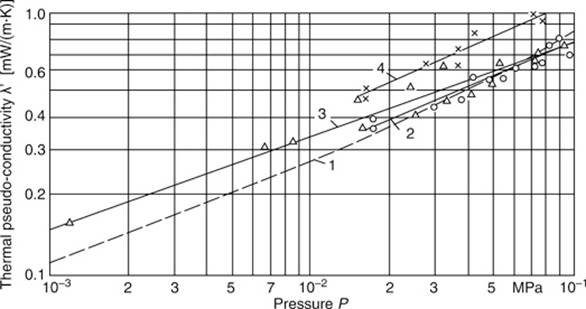
Fig. 5 - “Pseudo”- thermal conductivity, λ', of aluminium multifoil superinsulations, as a function of the compressive load, p. The figure is from [1]. Spacer materials for Curves 1 and 2: fiberglass paper of various thicknesses; for Curve 3: woven glass fabric, for Curve 4: perforated fiber-glass paper. Wall temperatures as in Fig. 4
|
Number |
Selected Gas |
Formula |
|
1 |
Air |
|
|
2 |
Hydrogen |
H2 |
|
3 |
Nitrogen |
N2 |
|
4 |
Oxygen |
O2 |
|
5 |
Helium |
He |
|
6 |
Neon |
Ne |
|
7 |
Argon |
Ar |
|
8 |
Krypton |
Kr |
|
9 |
Xenon |
Xe |
|
10 |
Carbon dioxide |
CO2 |
|
11 |
Carbon monoxide |
CO |
|
12 |
Steam |
H2O |
|
Number |
Material |
|
Nontransparent insulations |
|
|
1 |
Fumed Silicia + 16% Fe3O4 |
|
2 |
Pure boron silicate glass fibres, d=3 to 5 μm |
|
3 |
Fibre glass bonded mats, d=14 μm |
|
4 |
Fiberal (Al2O3 fibres), d=5 to 10 μm |
|
5 |
Boron silicate glass fibres + 30% Fe3O4 |
|
6 |
Boron silicate glass fibres + 3% Fe3O4 |
|
7 |
Polyesterfasern, d= 40 μm |
|
8 |
Polyester fibres, d= 26 μm |
|
9 |
Polyester fibres, d= 16 μm |
|
11 |
Polypropylene fibres, d=20 μm, pure |
|
12 |
Polypropylene fibres, d=20 μm, vacuum metallized with 0,05 μm Al |
|
13 |
Polypropylene fibres, d=20 μm, vacuum metallized with 0,10 μm Al |
|
Insulation with transparent zones |
|
|
10 |
Silicia-Aerogel, ρ ≤ 125 kg/m³, T1 ≤ 300 K |