Help for the VGAS module
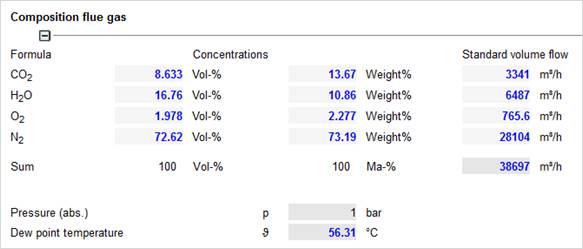
The VGAS module calculates the composition of the flue gas, which is produced from the combustion of gaseous fuels and fuell mixtures.
For a user-supplied fuel gas composition with up to 10 components, the program generates the combustion equations and calculates the stoichiometrically required air rate and resulting flue gas rate. For the actual air-to-fuel ratio the effective combustion air rate and flue gas composition (only main component) is then calculated. The case of incomplete combustion, i.e. when the air-to-fuel ratio is lesser than 1, is not considered.
The combustion of a pure gas (e. g. methane) with air follows the specific stoichiometric reaction equation.
......
For a gas mixture each component requires it's own separate reaction equation.
For a fixed fuel gas composition the oxygen needed for the stoichiometric combustion is computed by the reaction equations. The air and flue gas volumes are determined by a mass balance according to the ideal gas law.
With this button you specify the folder for the component list of VGAS in your network. This folder needs write access.
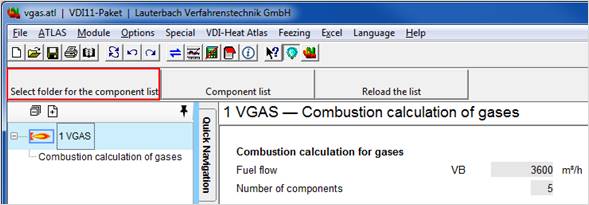
The name of the component list is GAS.TAB.
Please enter the number of components and then the single components by specifying their chemical formula:
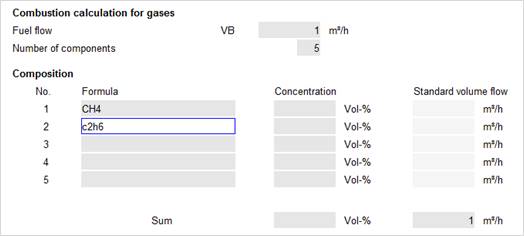
VGAS compares your input with a stored list of components. If the entered medium is part of the stored list, the input is accepted and the formula is displayed in capital letters. If the fuel is not part of the list you may add your fuel to the list:
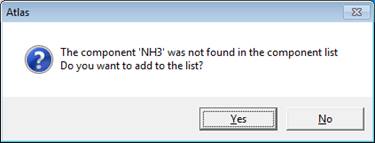
Confirm with ‚Yes’ and enter the number of C-, H-, O- and N-atoms of the fuel in the displayed input form and save it to the list with the ‚Save’ button.
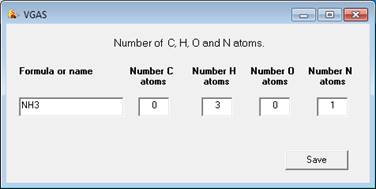
As soon as all components are entered with their volume concentration, the minimum amount of air required for the stoichiometric combustion is calculated.
Please enter a total fuel flow and an air ratio to calculate the amounts of flue gas and combustion air. Instead of entering the air factor you may as well enter the amount of combustion air. The LV equation solver will then calculate the air factor.
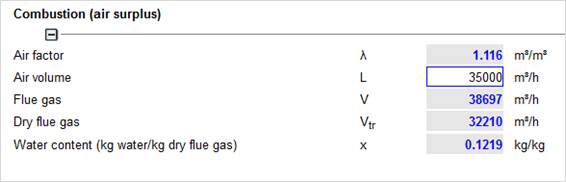
You may now use the concentrations of the main components of the flue gas for example in the RGAS module to determine the physical properties of the flue gas.