bil
From: Walter Bierwerth, Tabellenbuch Chemietechnik, 11th edition, Verlag EUROPA-LEHRMITTEL, Europe No. 70717, p. 439 ff.
Task:
In a mixture of benzene and toluene, the mass fraction of benzene is to be enriched by continuous rectification.
The plant is shown in the flow diagram (flow chart).
The mixture (pure two-substance mixture, ϑV = 20 °C) accumulates for separation with the following composition:
|
Benzene: mass fraction |
w1 = 25 % |
|
Toluene: |
w2 = 75 % |
Operating specifications:
Desired enrichment: w1 = 0.95 (column head), the sump effluent should still contain a maximum of w1 = 0.05 benzene.
|
Volume flow supply (feed): |
qV = 80 L/min |
|
Length of the supply line (straight pipe sections): |
L = 15 m |
|
Height difference feed pump/column feed (geodetic height): |
z = 4 m |
Feed to the column: boiling liquid
Outlet from the head condenser: boiling liquid
Cooling of the distillate in the distillate cooler to ϑ = 40 °C
Cooling water is available with a relative constant inlet temperature of ϑ = 20 °C and should not be warmer than ϑ = 30 °C when leaving the plant.
The column is operated at normal pressure.
Components to be designed:
Centrifugal pump (feed pump): Required pump capacity via pressure drop in the feed line
Mixture preheater (electric pipe heating, inductive): required heating power?
Separation column (packed column): required number of theoretical stages according to McCabe-Thiele
Head condenser (shell-and-tube heat exchanger): required exchange area
Distillate cooler (shell-and-tube heat exchanger): required exchange area
Distillate receiver (horizontal cylindrical buffer vessel with dished ends): Level diagram qV = f(h)
Required fittings and other piping parts in the feed line:
2 bends (elbows) 90°, R/d = 4
1 Globe valve (DIN valve)
1 Shut-off valve (ball valve), 50 % open
1 Check valve
1 Vortex counter
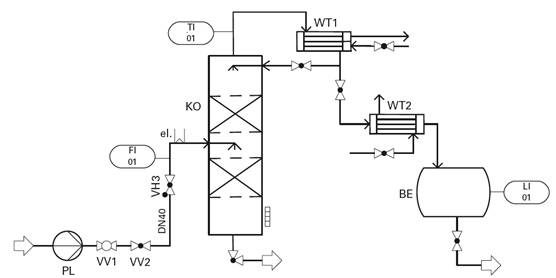
Electrical heating of the feed inlet to boiling temperature - required electrical power
Mass flow Inlet:
qm = qV · ϱM = 0,00133 m³/s · 869,9 kg/m³ = 1,16 kg/s
Specific heat capacity of pure substances (p. 110/111)
cpB = 1740 J/(kg · K) cpT = 1710 J/(kg · K)
Specific heat capacity of the mixture (p. 79)
cM = wB · cpB + wT · cpT = 0,25 · 1740 J/(kg · K) + 0,75 · 1710 J/(kg · K) = 1717,5 J/(kg · K)
Conversion of electrical energy into thermal energy (p. 91):

Required electrical power: P = 173974.2 W