EN 11 module
Considering external shear forces and considering an external torsional moment due to an increased torque
To be able to transfer a transverse force Q (orthogonal to piping axis) and a torsional moment Mt in a flanged connection by frictional connection, an additional force Fz must act at the gasket.
FZ is:
aa) for laterally movable flanges, which can transfer transverse forces only by frictional connection

ab) for laterally unmovable flanges, that can transfer transverse forces only by form locking.

If Fz results as < 0 from the equations (A 2.8-10) or (A 2.8-11), Fz has to be added to the required operational gasket force according equation (A 2.8-5).
N o t e :
Metal O-ring seals are not suitable for bearing transverse forces and torsional moments caused by frictional connection.
If there are no other experimental results, enter the friction factors as follows:
m = 0,1 for graphite layered gaskets
m = 0,15 for metal layers with smooth surface
m = 0,25 for It gaskets
|
Symbol |
Description |
Unit |
|
FZ |
Axial tensile force for transferring transverse forces and torsional moments by frictional connection under operating conditions |
N |
|
FDB |
Required gasket force for design load case |
N |
|
MB |
Bending moment in tube |
N mm |
|
Mt |
Torsional moment in tube |
N mm |
|
dD |
Average gasket diameter |
mm |
|
dt |
Bolt circle diameter |
mm |
|
m |
Friction factor |
- |
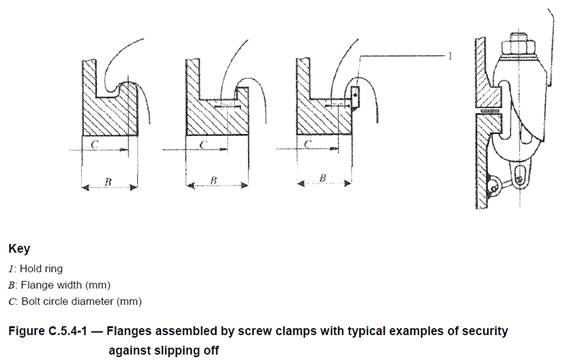
Screw clamps, see Figure C.5.4-1, shall be verified as suitable.
They shall be secured against slipping off, and they shall be attached to the vessel so that they cannot fall off when hinged down.
The number, size and quality of the screw clamps of each closure shall be indicated on the manufacturer name
plate on the vessel.
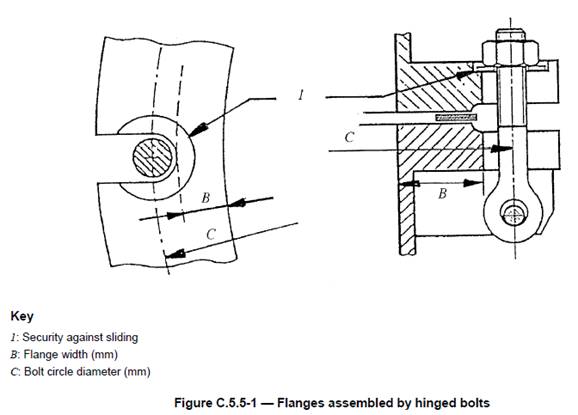
Hinged bolts to be swung into slots (e.g. eyebolts) shall be secured against slipping off, see Figure C.5.5-1. Nuts
and washers shall bear on the entire surface outside the slot.
This value is transferred from the material database. The user might overwrite this value, which is then presented in red.
If you want to fall back to the value from the material database, delete the variable by right-clicking the combo box and selecting ‘Delete variable’.
This value is transferred from the material database. The user might overwrite this value, which is then presented in red.
If you want to fall back to the value from the material database, delete the variable by right-clicking the combo box and selecting ‘Delete variable’.
This value is transferred from the material database. The user might overwrite this value, which is then presented in red.
If you want to fall back to the value from the material database, delete the variable by right-clicking the combo box and selecting ‘Delete variable’.