Variable list
Specifies the filter density according the following equation: G = M / V, where M = Mass of filter, V = Volume of filter
This factor considers that not all fibers
are arranged orthogonally to the flow direction.
Acc. [Bürkholz, page 142] f = 0.8
The Relative flow cross section area indicates
how often one particle hits the filter while passing it.
Acc [ Bürkholz, page 142] p = f L D / F.

Friction factor of cylinder at crossflow
The correction factor a*
serves for calculating the effective diameter Deff by the
characteristic diameter D*:
Deff = a* D*.
The effective diameter gives a single curve ΔP ( dp50 ) for several separators. According [ Bürkholz, page 60] for a wire mesh demister and a fibre filter a* = 1.
Location parameter of separation efficiency curve. This particle size corresponds a separation efficiency of 50%. Frequently used as limiting particle size.
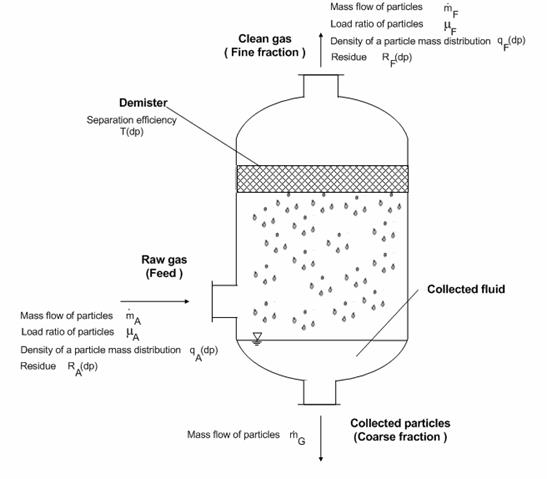
The separation efficiency presents the ratio of the particles in the feed and the particles in the coarse fraction for every particle diameter dp. T(dp) = 0 an, if all particles of size dp pass the separator, T(dp) = 1, if all particles are separated.
The selectivity is a measurement for the separation quality. It presents the slope of the separation curve. The closer the selectivity is to one, the closer the process is to the ideal separation.

Parameters for inertial separation are a group of dimensionless parameters. They are introduced by Buerkholz, to calculate the total separation efficiency for several different inertial separators. The group contains physical properties of gases, wire density, pressure differences, wire diameter and particle diameter. [ Bürkholz, (6-15)].
The mean parameter for inertial separation is calculated at the limiting particle size dp50.
The distribution rule gives the relation of the mass fraction of narrow particle size fractions to the particle size ( see DIN 66144 [2] ).
According [ Zogg, page 27] 3 rules can be selected:
· Logarithmic standard distribution ( DIN 66144 )
· Rosin-Rammler-Sperling-Bennet-Distribution (RRSB-distribution) (DIN 66145 )
· Gates-Gaudin-Schuhmann-Equation (GGS-distribution ) (DIN 66143).
The particle parameter dpm is a linear measurement for the according distribution rule.
Logarithmic standard distribution (DIN 66144)
Parameter R=0.5.
RRSB-distribution (DIN 66145)
Parameter R=0,368
GGS-distribution (DIN 66143).
Maximum value for particle size. For dp>dpm R=0.
The dispersion parameter n characterizes the slope of the residue curve.
For the logarithmic standard distribution n is the standard deviation, where n=ln (dp50/dp16).
Caution! For values n > 1 long calculation times may occur!
Residue R(dp) means a relative rest amount (mass) of particles with a diameter greater than dp.
Residue R(dp) means a relative rest amount (mass) of particles with a diameter greater than dp.
With separators for gas cleaning, a decontamination factor DF is used:

A high decontamination factor means a good cleaning effect.
This condition shows how often dpmax is larger than the limiting size dp50. This value must be increased until the desired preciseness for dp95 is reached.
Caution! For high values there might be long calculation times!
The mean value dp50 corresponds with a residue R = 0.5
The particle size dp95 corresponds with a residue of R=0.05. The particles with a diameter dp < dp95 add to 95% of the weight of the feed.