Frequently asked questions
Q: My customer does not or cannot state if the forces and moments apply at the nozzle end or the sectional plane. Which option shall I choose?
A: In this case please select ‚Sectional plane‘. This leads to higher stresses and therefore you are ‚on the safe side‘.
Q: Can I increase the accuracy of the results by refining the mesh?
A: No. The calculation method refers to defined closed elements. The elements themselves may be 2D plates, 2D triangular elements or bodies like blocks or tetrahedrons. These elements have the ideal shape to receive the most accurate results. If the body to be calculated is meshed with elements that are close to ideal shape, you call this mesh an ‘aesthetic’ mesh.
If you now would decrease the size of the elements, they would diverge from the ideal shape. For example the surface would get unproportionally smaller than the material thickness. Additionally the transitional area from nozzle to shell is a point of discontinuity, where the stresses may be mathematically infinite. It does not really make sense to mesh this area with very small elements.
Q: I have received an allowable utilization with the WRC module. The FEM calculation shows overstress. Should the FE calculation not show a lower utilization?
A: You cannot generalize this phenomenon. The "Welding Research Council" has only examined stresses in the basic body. The stresses in the weld and in the nozzle were not considered. An overstress by FEM may therefore occur in the weld and the nozzle.
Q: Should there not be higher loads if the loads apply at nozzle end and not at the sectional pane?
A: Usually this is vice versa. The assumption would be reasonable if all bodies were rigid. But the membrane of the shell and the nozzle itself are flexible structures and influence each other. A rubber nozzle would not cause stresses in the basic body. One advantage of the FE calculation is that this more or less flexible structure can be calculated. A rigid nozzle would move the load in direction of the weld and the basic body, which will avoid this load by deformation. A flexible nozzle will bear the load by its own deformation.
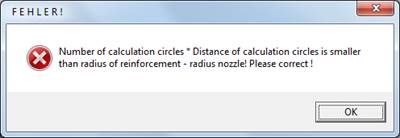
Please adjust FEM parameters accordingly.
The quality of the volume elements is highest in this range. We recommend a setting to this range.
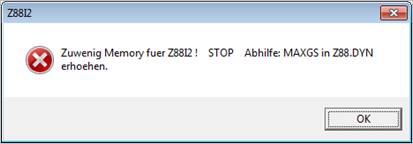
Check the geometrical data of the basic body (considered length)!
It is not necessary to model the complete basic body. Only the nozzle area is examined.
Please adjust the considered length accordingly.
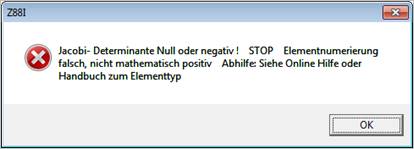
Bad mesh. One or more finite elements are outside the range of validity.
Please check if there are great differences in the wall thicknesses of the shell and the nozzle and a displaced nozzle.
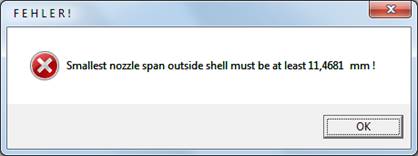
Please increase nozzle length or decrease element size.